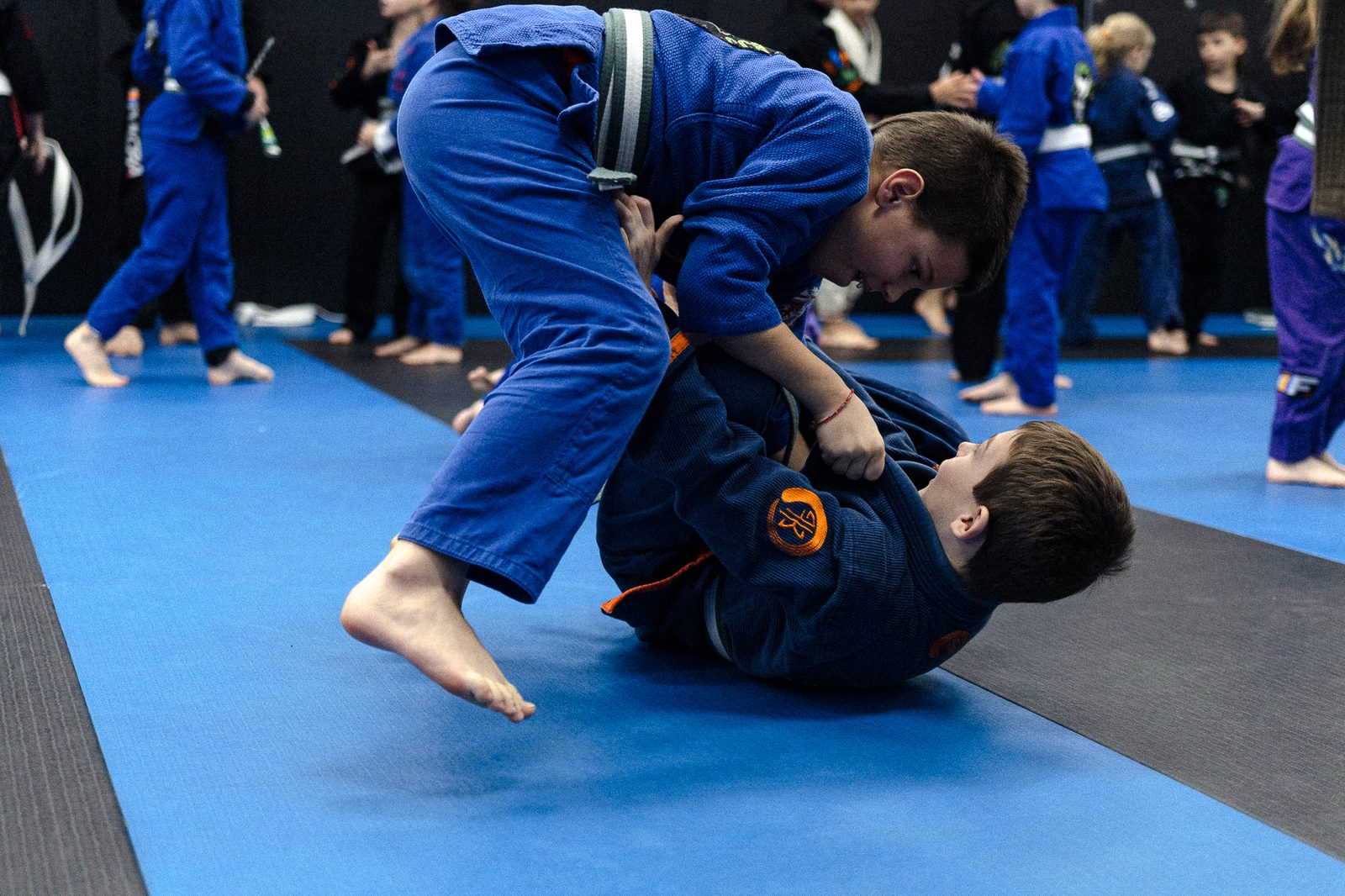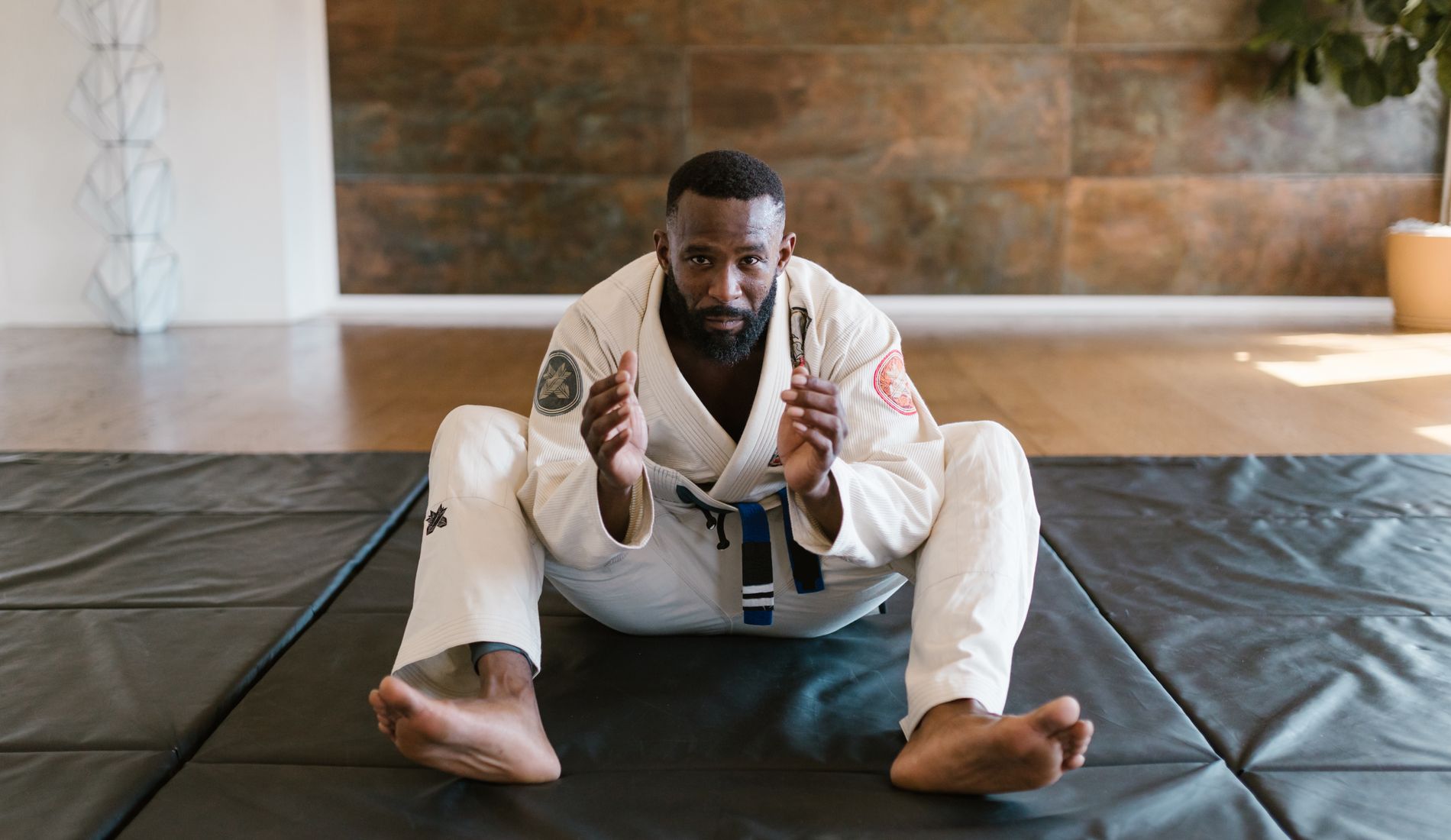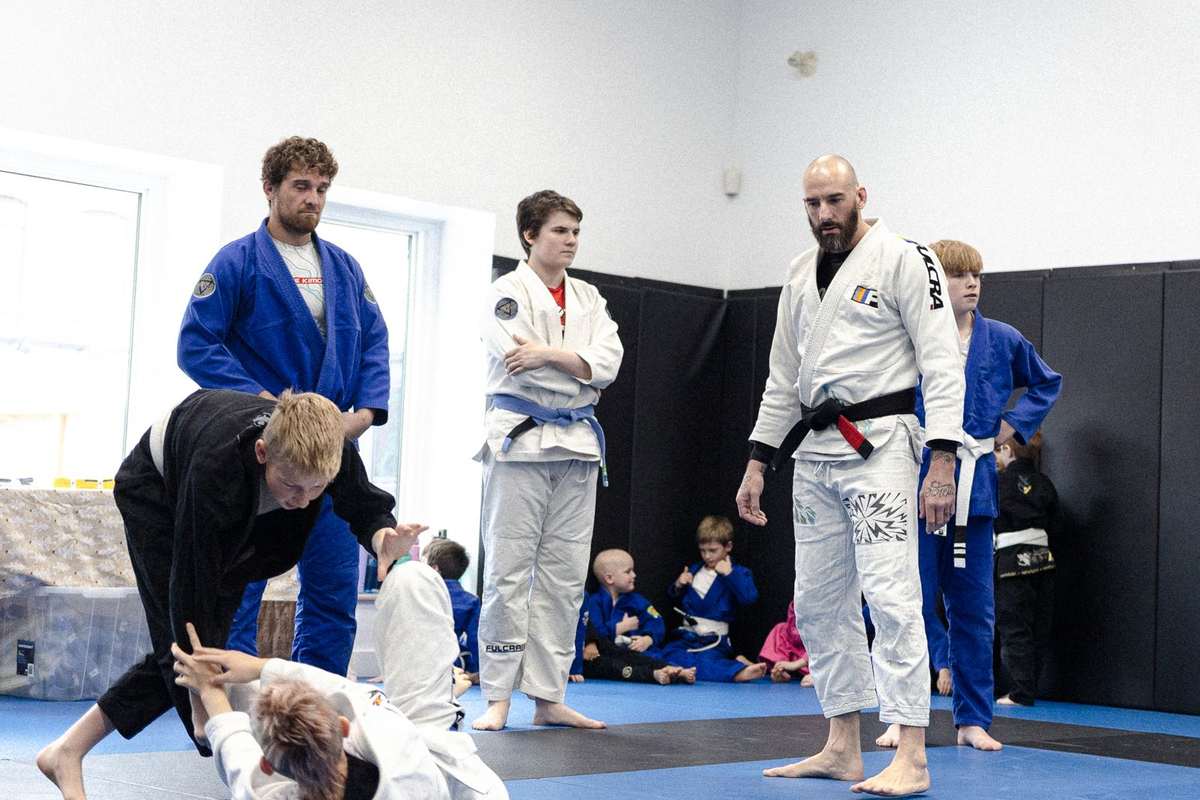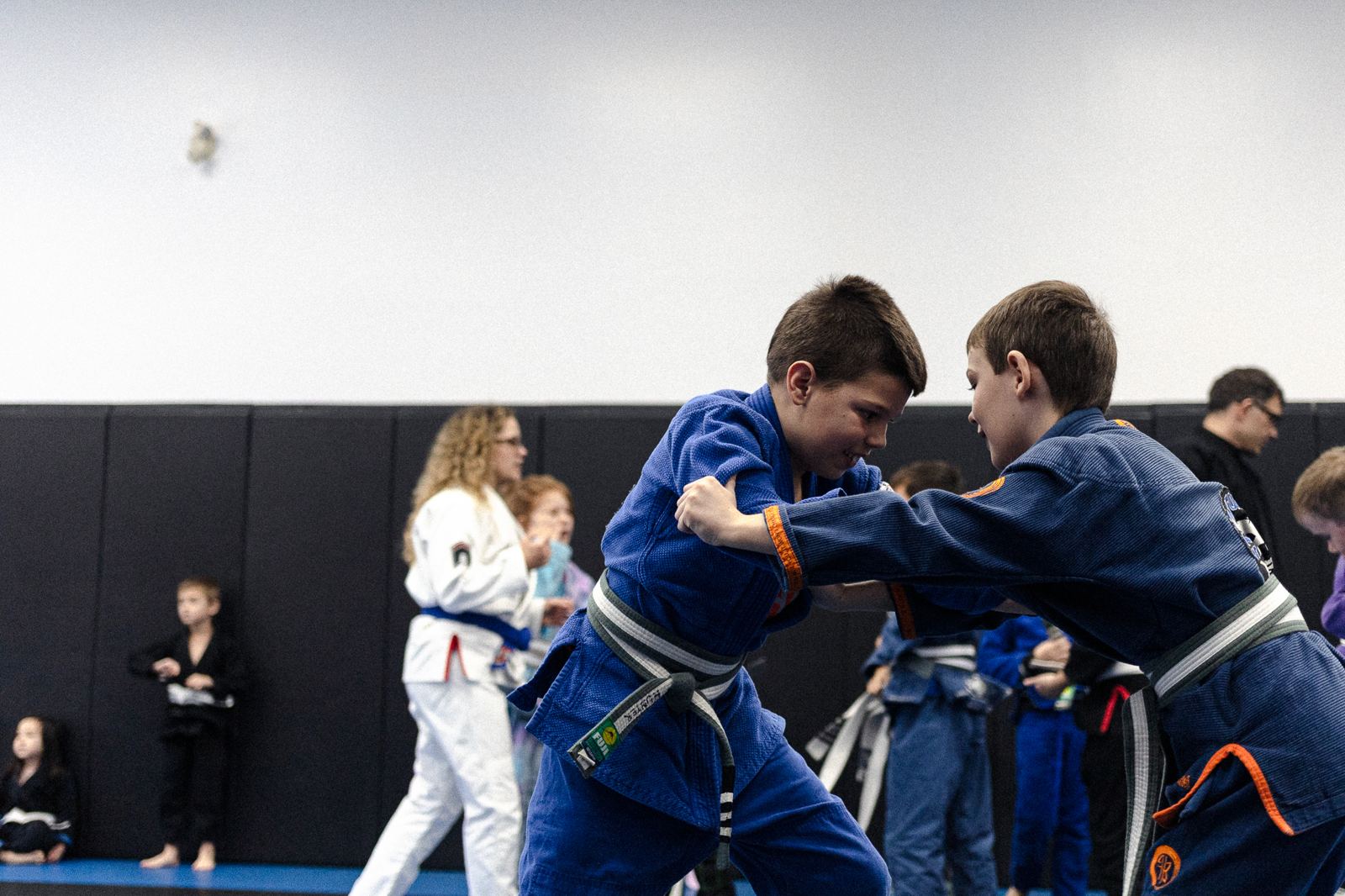
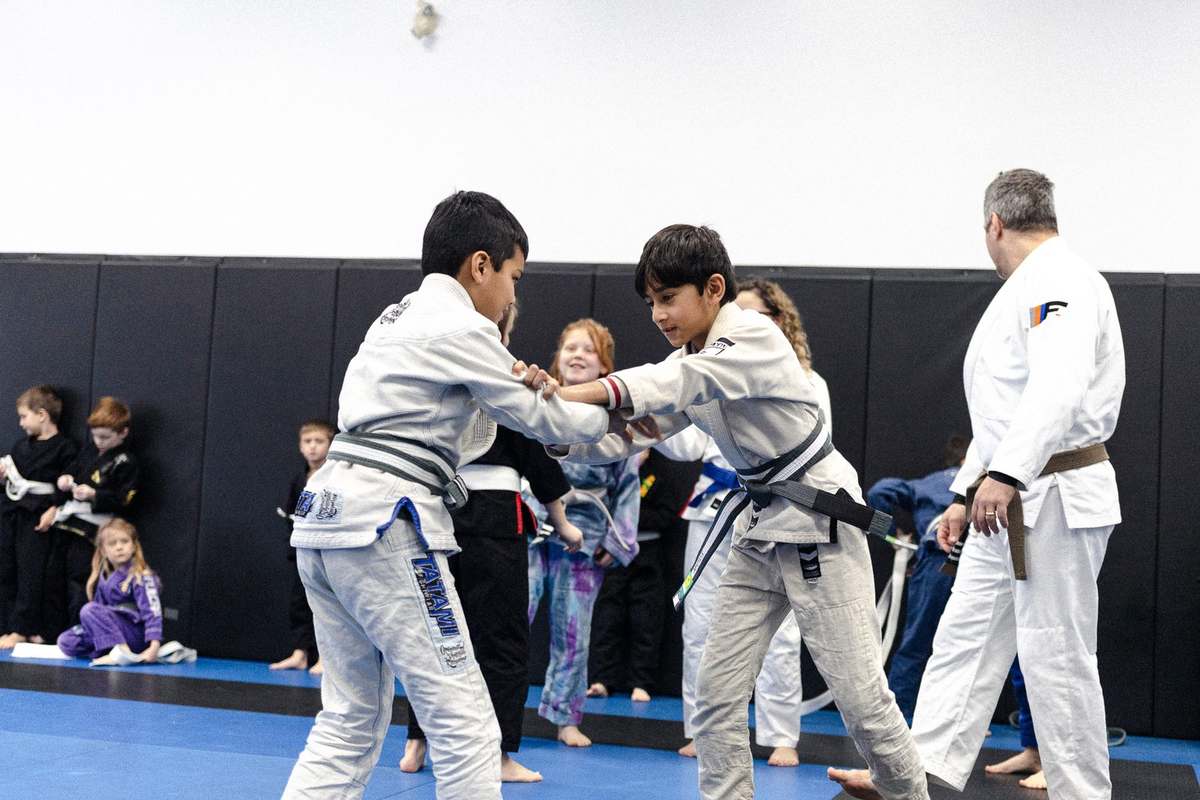
Judo vs jiu jitsu is one of the most common questions we hear at the door, usually from someone who has already decided to start grappling and wants to pick the right room. The two arts are cousins, and both grapple: no strikes, only grips, throws and holds. Judo is built around throws and takedowns. Brazilian Jiu-Jitsu (BJJ) is built around what happens once the fight reaches the ground. We teach both under one roof in Stratford, so here is a plain comparison from coaches who watch the crossover happen every week.
Judo vs jiu jitsu: key differences at a glance
Here are the similarities and differences between judo and jiu-jitsu in one place.
- Judo was created in Tokyo in 1882 by Jigoro Kano, and BJJ grew out of judo after Mitsuyo Maeda brought it to Brazil in the 1920s.
- Judo is decided mostly on the feet: one clean throw can end a match, and in judo competitions roughly 70 to 90 per cent of the time is spent standing.
- BJJ is decided mostly on the ground: roughly 80 to 90 per cent of a BJJ match is spent there, and a submission ends the match at any score.
- Judo has been an Olympic sport since 1964 for men and 1992 for women, while BJJ is not on the Olympic program.
- At Stratford BJJ, Judo runs on Sundays and Brazilian Jiu-Jitsu runs six days a week, so you can try both in the same week.
Where does each martial art come from?
Judo came first. Jigoro Kano built it from the older art of jujutsu and opened the Kodokan Judo Institute in Tokyo in 1882. His student Mitsuyo Maeda carried judo to Brazil and taught Carlos Gracie in the 1920s, and the Gracie family spent decades reshaping the ground side of the art into Brazilian Jiu-Jitsu.
That shared root is why judo and Brazilian jiu jitsu look so similar on day one: same gi (the heavy cotton jacket, pants and belt), same grips, same idea of leverage over strength. The difference between judo and jiu jitsu is where the match is decided, and what the rules reward.
Difference 1: judo throws and BJJ ground fighting
Judo focuses on the stand-up game. A judoka (a judo practitioner) spends most of a class on grip fighting, off-balancing a partner and the throws in judo that put someone flat on their back. A judo ground pin can win a match, but the referee stands both athletes back up as soon as the action stalls.
Unlike judo, BJJ keeps the match going once you are on the mat, so the art has had a century to build its ground techniques: guard (fighting off your back with your legs between you and your partner), guard passing, mount or back control (sitting on top of or behind a pinned partner) and the submissions from the ground that finish each. A BJJ practitioner learns takedowns too, but they are the front door, not the house.
Difference 2: how you win in judo and BJJ
Under current International Judo Federation rules, a match ends the moment one athlete scores ippon: a throw that lands a partner on the back with speed, force and control, a pin held for 20 seconds, or a submission by choke or elbow lock. Grabbing the legs while standing has been banned since 2010, and joint locks are limited to the elbow.
BJJ under the International Brazilian Jiu-Jitsu Federation rewards progress toward control. You earn points for each better position you reach, and a submission (joint locks and chokes your partner taps to) ends the match no matter the score. Tapping is the safety valve in both arts: you tap, your partner lets go and you reset.
| Comparison point | Judo | Brazilian Jiu-Jitsu |
|---|---|---|
| Instant win | Ippon by throw, 20-second pin or submission | Submission at any time |
| Points | Waza-ari (half point); two make a win | Takedown 2, sweep 2, guard pass 3, mount 4, taking the back 4 |
| Legal joint locks | Elbow only | Elbow, shoulder and, at higher belts, legs and ankles |
| Leg grabs standing | Banned since 2010 | Allowed |
| Ground time | Short, restarted when stalled | Open-ended |
Difference 3: uniforms, grips and the black belt
A beginner can wear the same uniform to either class. A judogi is cut heavier and looser to survive being yanked through a throw, while a BJJ gi is trimmer to give a partner less cloth to grip. BJJ also runs a no-gi version in a rashguard (a snug athletic shirt) and shorts, where you grip the body instead of the fabric. Judo is always trained in the gi.
Belts move at different speeds. A steady adult can commonly reach a black belt in judo in a few years. A BJJ black belt commonly takes about a decade compared to judo, with only five adult belts along the way. Neither belt is better. The difference between judo and BJJ belts is what they measure.
Difference 4: where the injuries tend to happen
Both arts carry injury risk, and no honest coach will promise zero. In judo, most injuries happen in standing exchanges while throwing, being thrown or fighting for grips, and the shoulder, collarbone and hands take the brunt. A systematic review of judo injuries found sprains to be the most common type.
In BJJ, the knee and the elbow lead. Elbow injuries come mostly from armbars held too long, and knee injuries from guard passing, takedowns and sweeps. That is why we teach two habits first: in judo, breakfalls (how to hit the mat and get straight back up), and in BJJ, tapping early. A coach in the room the whole time lowers the risk in both.
Difference 5: what each does for self-defence
For self-defence, judo and jiu-jitsu answer different halves of the same problem. Judo teaches you to stay on your feet, break someone's balance and take an attacker to the ground hard. BJJ teaches you what to do if the fight goes to the ground: how to get back to your feet or control an opponent on the ground without striking. Neither martial art asks you to be bigger or stronger than the other person, and that is the whole point of both.
Which martial art should you try first?
Train in judo first if you want to learn throws and fall safely. It is also an easy entry point for kids aged 6 and up, because falling well carries into every playground and sport.
Try Brazilian Jiu-Jitsu first if you want a slower puzzle, would rather start on the ground than be thrown on day one, or want the widest choice of class times. Our BJJ Basics class for teens and adults runs Monday and Wednesday at 7:00 pm and Friday at 6:00 pm, and the full schedule shows every option by age.
Still torn? Do both. Judo sharpens the takedown that starts every BJJ roll (live training), and jiu-jitsu techniques supply the ground control that finishes a judo throw.
How judo and BJJ fit together at Stratford BJJ
Stratford BJJ has run Brazilian jiu jitsu classes on Downie Street since December 2013, and judo classes now run on Sundays alongside them. Kids and Youth Judo takes the mat first for ages 6 to 12, followed by the Judo class for teens and adults, all in uniform and all starting with breakfalls. A loaner uniform is waiting for your first class. Families come to us from across Perth County, including St. Marys, Mitchell and Sebringville.
Our lineage supports both arts. Professor Ryan O'Shea, our founder and head coach, is a third-degree black belt under Professor Jorge Britto in the Royler Gracie line and a founding member of the Jiu-Jitsu For Life Team, with a background in wrestling, judo and MMA. Coach Alex Schweinsberg holds black belts in both BJJ and Judo. You can meet the coaching team and browse every program before you visit.
Want to see it for yourself? The first class is free.
Book Your Free Intro Class →What people who train with us say
These are real Google reviews from people who train with us, quoted as they wrote them.
“The class was taught by Ryan. We mostly worked on take-downs (arm drags and collar ties), good fundamental moves.”Aaron Stephan, Google review
“...he harbours a serious amount of knowledge in Brazilian jiu-jitsu and explains it in precise detail.”Sarah Garrity, Google review
“The coaches are top notch: professional, knowledgeable, and supportive.”Evaline W, Google review
Still weighing judo vs jiu jitsu? The quickest way to decide is to feel each one. Book a free intro class, tell us which art you are curious about, and we will meet you at the door and take it from there.
Frequently asked questions
Neither wins outright. Judo puts a person on the ground quickly from standing, and BJJ controls them once you are there. Training BJJ and judo together is the most complete answer.
Judo is harder on the body early, because being thrown takes getting used to, while BJJ is harder on the brain, because there are more positions to remember. Whatever your skill level, beginners in both start with falling, posture and simple escapes.
Kids and Youth Judo starts at age 6 and runs Sunday mornings for ages 6 to 12. Breakfalls come first, and nobody takes a throw until they can land one safely. Our contact page is the fastest way to ask about placing your child.
This article is for general information only. Always train under qualified supervision and consult a physician before starting a new physical activity.