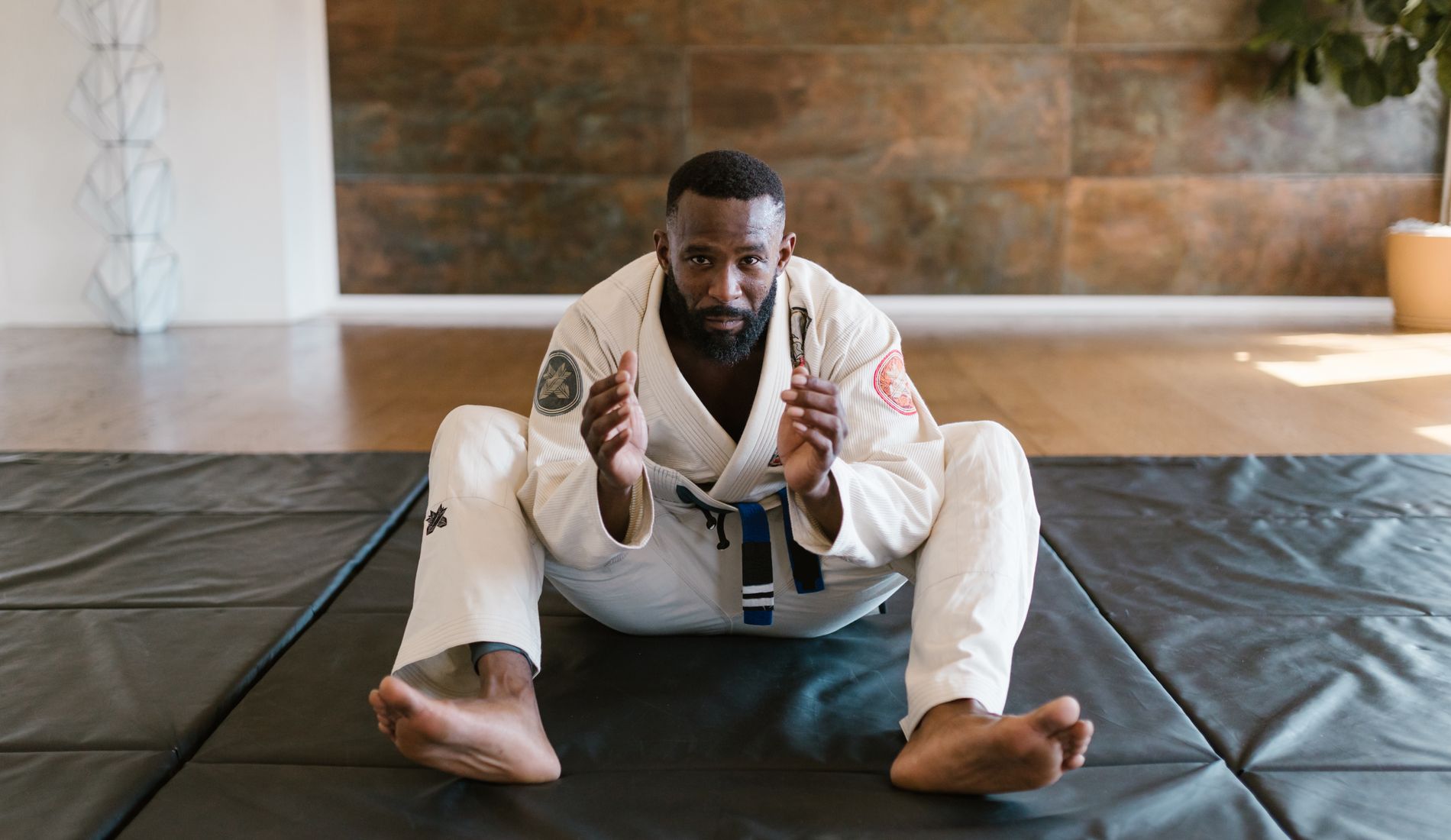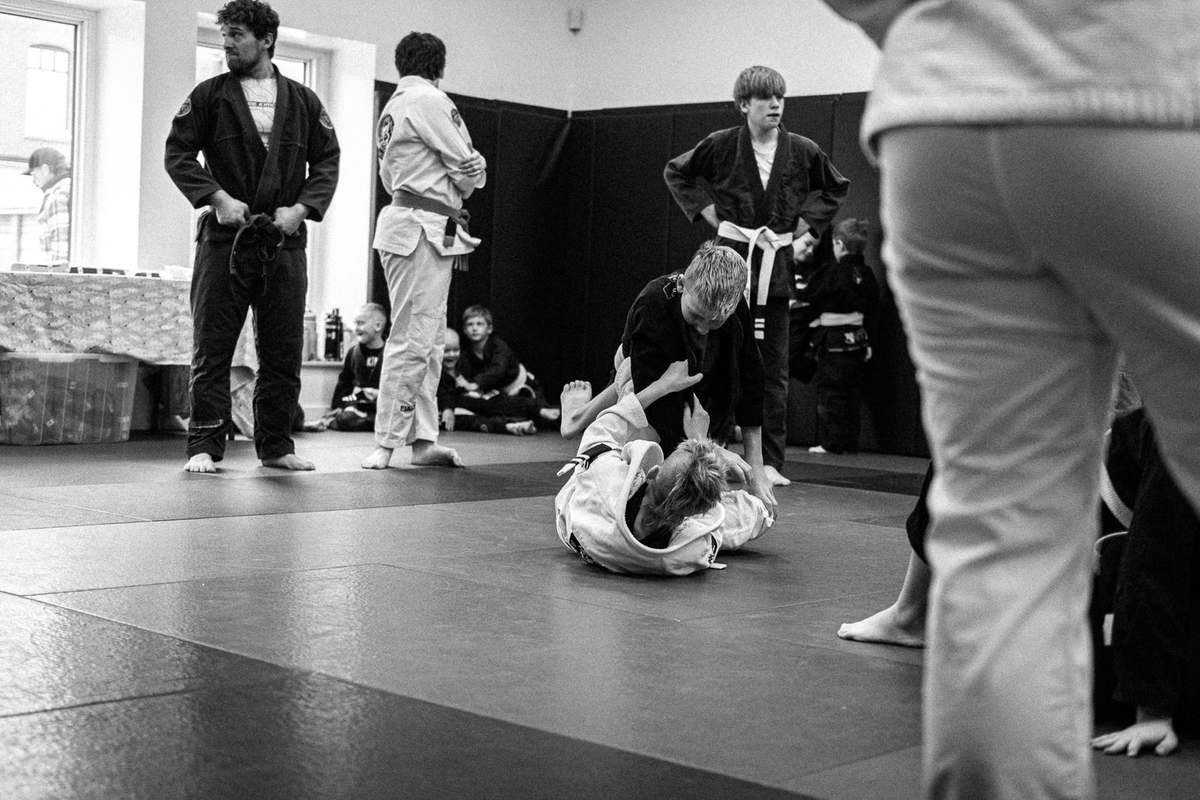
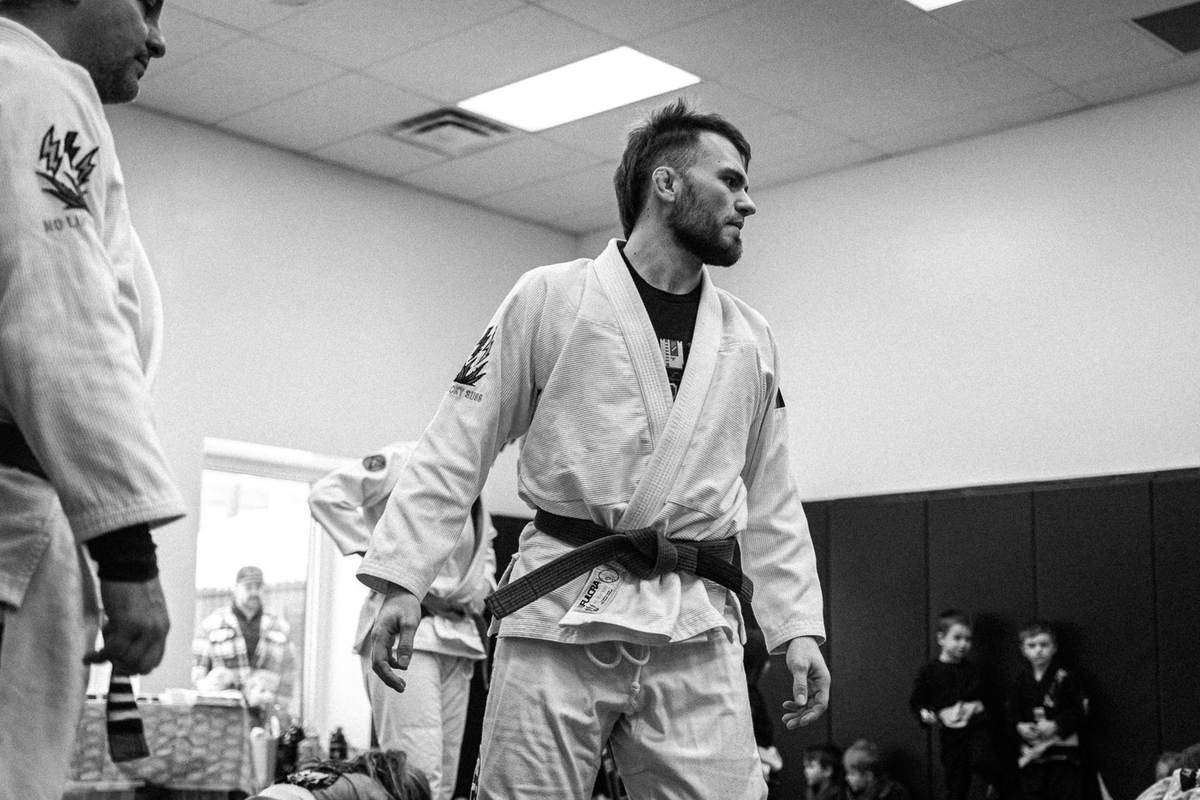
If you have ever watched a class and wondered what all the coloured belts mean, you are not alone. Brazilian jiu jitsu belts follow a clear order, from white to black, and each one takes real time on the mat. Here is the full BJJ belt system, what the stripes mean, honest time ranges for each step and what a coach actually looks for before a promotion.
Key takeaways
- The adult BJJ belt order is white, blue, purple, brown and black, and most adults spend about 8 to 15 years getting from white belt to black belt.
- Under the International Brazilian Jiu-Jitsu Federation (IBJJF) system, an adult must spend at least 2 years at blue belt, 1.5 years at purple belt and 1 year at brown belt.
- White, blue, purple and brown belts can each carry up to 4 stripes, which mark progress inside a belt rank.
- Kids under 16 train in their own belt system (grey, yellow, orange and green groups) and move to adult belts at 16.
- A typical adult who trains 2 to 3 times a week reaches blue belt in roughly 1 to 3 years.
What is the BJJ belt order and ranking system for adults?
The adult ranking system has five main colours. The IBJJF (the sport's largest governing federation) sets minimum ages and minimum time at each belt, but the time it actually takes is longer for almost everyone.
| BJJ belt | Minimum age (IBJJF) | Minimum time at this belt (IBJJF) | Typical time at this belt |
|---|---|---|---|
| White belt | Any age | No minimum | 1 to 3 years |
| Blue belt | 16 | 2 years | 2 to 3 years |
| Purple belt | 16 | 1.5 years | 1.5 to 3 years |
| Brown belt | 18 | 1 year | 1 to 2 years |
| Black belt | 19 (18 only for an adult brown belt world champion) | 31 years before the red and black belt | A lifetime of learning |
The typical ranges come from common published timelines for adults training a few times a week. They are ranges, not promises. Injuries, work shifts, a new baby or a winter off all stretch the clock, and that is normal.
What each belt level means
Your first jiu-jitsu belt is white, and every belt rank after it reflects a new stage of understanding.
- White belt level: you learn to survive, escape and understand the basic positions.
- Blue belt level: you have a working defence and a small set of attacks you trust.
- Purple belt level: you start building your own game and helping newer members.
- Brown belt level: you refine, tighten details and fix the gaps in your game.
- Black belt level: you have a deep, complete understanding, and the learning keeps going.
How do stripes work on a BJJ belt?
Stripes are small progress markers, usually pieces of white athletic tape wrapped around the black bar at the end of the belt. Under the IBJJF system, white, blue, purple and brown belts are each divided into 4 degrees, so you will often see up to four stripes before the next belt. Below brown belt, the IBJJF leaves the stripe system to the professor's discretion.
That means stripes are not handed out on a fixed calendar. For a new white belt, the first stripe is a big day, because it means the coach has noticed you showing up and getting better.
What is the kids belt system in Brazilian jiu-jitsu?
Kids have their own ranking. They do not wear blue or purple belts. Brazilian jiu-jitsu students under 16 move through four colour groups, and each group has a white-striped, solid and black-striped version of the belt.
| Kids belt group | Ages (IBJJF) | Versions |
|---|---|---|
| Grey | 4 to 15 | Grey and white, grey, grey and black |
| Yellow | 7 to 15 | Yellow and white, yellow, yellow and black |
| Orange | 10 to 15 | Orange and white, orange, orange and black |
| Green | 13 to 15 | Green and white, green, green and black |
There is no IBJJF minimum time at each kids belt. When a young athlete turns 16, a grey, yellow or orange belt moves to blue belt, and a green belt can move to blue or purple at the professor's decision. You can see our Kids and Youth and Teens classes on our programs page.
How long does it take to get a blue belt in BJJ?
For an adult who trains 2 to 3 times a week, blue belt usually takes about 1 to 3 years. Some people get there faster with a wrestling or judo background. Others take longer because life gets busy, and that is fine.
What speeds it up is not talent. It is consistency. Two classes every week for a year beats five classes a week for a month and then six months away. A roll (live sparring with a partner) teaches a lot, and so does a slow drill (repeating a technique with a cooperative partner). The tap, a quick double tap on your partner or the mat, ends every exchange safely, so you can train hard and keep coming back.
What a coach looks for at promotion time
At Stratford BJJ, belts are earned, not given. Promotions run on a clear rubric, not attendance alone. To move to the next belt, you show three things:
- Technical understanding: you can explain and perform the core positions and escapes for your belt level.
- Mat hours: you have put in steady, real time on the mat.
- Live application: you can use your jiu jitsu against a resisting partner, not only in a drill.
When you get a new belt here, everyone in the room knows you earned it, and so do you. We can walk you through your first class step by step, and nobody is asked to roll on day one.
Black belt, coral belt and red belt: the highest Brazilian jiu jitsu belts
A BJJ black belt is not the end of the road. The black belt has six degrees, marked on a red bar. The first three degrees can each be requested after 3 years, and the 4th, 5th and 6th after 5 years each.
After that come the coral belts, which few people ever wear. The red and black belt is the 7th degree black belt, and the red and white belt is the 8th degree black belt. The red belt is the 9th degree, and the 10th degree red belt was reserved for the founding Gracie brothers, the pioneers of Brazilian jiu-jitsu.
Why lineage gives the BJJ ranking real meaning
A jiu jitsu belt is only as good as the person who ties it on you. That is why lineage, the chain of teachers behind your coach, matters in jiu jitsu. Our founder and head instructor, Professor Ryan O'Shea, is a 3rd-degree black belt under Professor Jorge Britto in the Royler Gracie line, and a founding member of the Jiu-Jitsu For Life Team. You can read more about the whole coaching team on our instructors page.
Coach Ryan opened Stratford BJJ in December 2013, the original academy in Stratford. Since then, the academy has grown its own black belts. Greg Neeb, one of our most consistent members since day one, earned the academy's first home-grown black belt. When families from Stratford, St. Marys, Mitchell and the rest of Perth County see a belt promotion on our mats, they are watching a rank that traces straight back to the family that built the art. Read the full story on our about page.
Want to see it for yourself? The first class is free.
Book Your Free Intro Class →What members who earned their belts here say
These are real Google reviews from people who train with us, quoted as they wrote them.
“I have been training at Stratford BJJ for 10 years now. It has been a blessing and life changer. I have made a lot of great friends and have gained confidence and strength.”Jocelyn Johnson, Google review
“The coaches are world class and are not only technical but also patient and genuinely invested in every student’s progress.”Solochance, Google review
“Been coming here for 2+ years, and it's been a consistent joy in my life.”Evaline W, Google review
Every black belt on our mats started as a nervous white belt with no stripes. Brazilian jiu jitsu belts take time, and the first step is the easiest one. Ready to step on the mats? Book a free intro class and we will take it from there.
Frequently asked questions
Adults have five main belts: white, blue, purple, brown and black. Above black belt sit the red and black, red and white and red belts. Kids under 16 have their own grey, yellow, orange and green belt groups.
Yes. White, blue, purple and brown belts can each carry up to 4 stripes, which show progress inside a belt. The black belt carries up to six degrees on its red bar.
Most adults who train steadily take about 8 to 15 years from white belt to black belt. The IBJJF minimum from blue belt to black belt is 4.5 years, but almost nobody moves that fast.
No. Kids under 16 move through the grey, yellow, orange and green groups. At 16, they move into the adult belt system, usually at blue belt.
This article is for general information only. Always train under qualified supervision and consult a physician before starting a new physical activity.